Envelope Budget: Money Planner
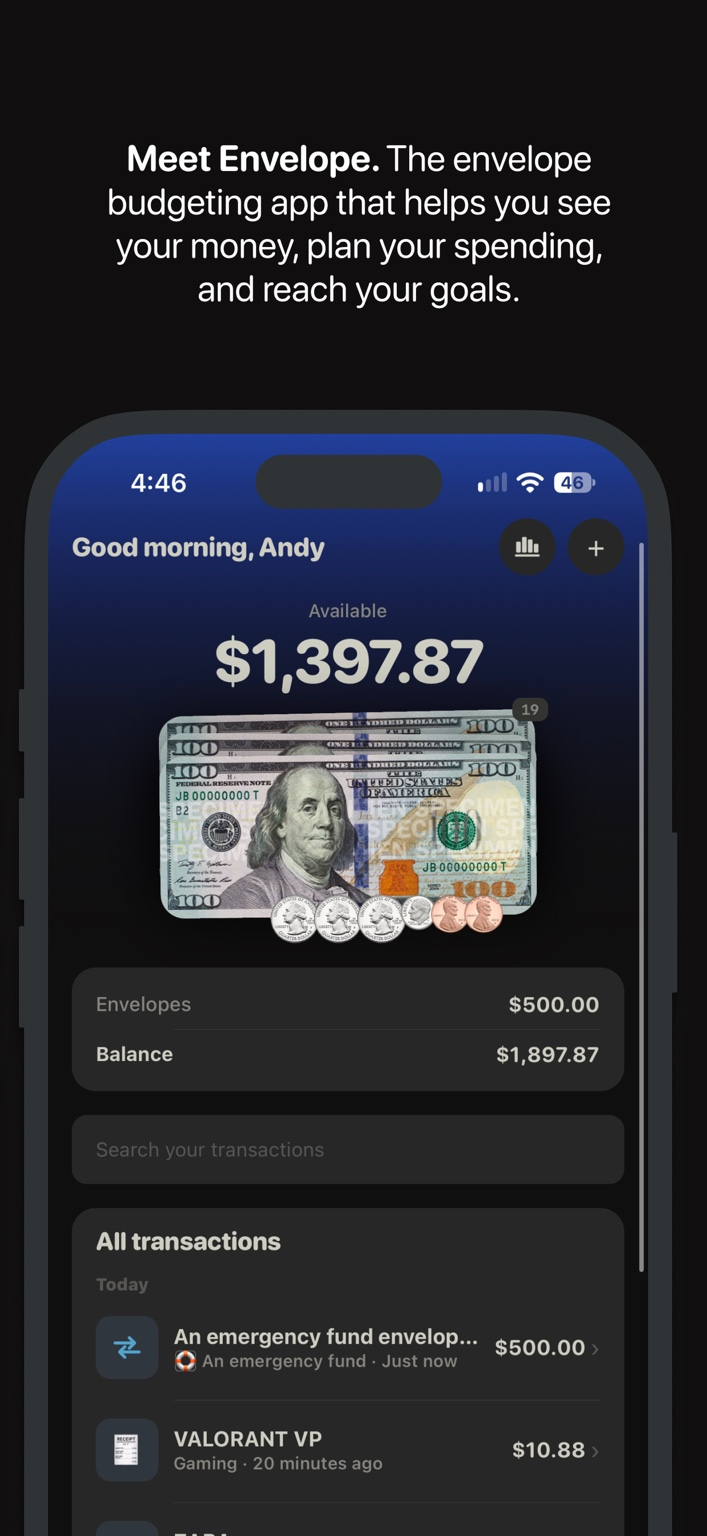
The envelope budgeting app that helps you see your money, plan your spending, and reach your goals.
Product Engineer
2026 – Present
Solo project
Product Design, iOS Development, Prototyping
Give every dollar a job
As technology has changed the way we use money, physical cash has gradually become less common. Most of our money now exists as numbers on a screen. We receive a paycheck, swipe a card, pay a bill, or buy something online, and the only visible indication that anything happened is a number changing in our bank account.
While digital money has made spending and managing money significantly more convenient, I think it has also created a disconnect between money and the act of spending it. When you have $100 in cash, spending $40 is immediately understandable. You physically had $100, $40 left your hands, and now you have $60. With digital money, that same transaction can feel much less tangible. You tap a card, and suddenly your balance is different.
This app is built around the idea that we shouldn't have to use physical money to have a physical understanding of money.
The opportunity was to close that gap without asking anyone to go back to carrying cash. A ledger provides a clear record of what has happened, while an envelope system provides a clear understanding of where money currently belongs. Together, they create a more intuitive picture of a person's finances: not just that a balance went down, but what money moved, where it moved from, where it went, and what remains.
The goal was never to recreate physical cash or make digital money behave exactly like it did in the past. It was to bring some of the clarity and awareness that came naturally with physical money into the way we manage money today, and to build that around a practical, everyday budgeting and ledger tool.
Designing with intention.
The app is built around the belief that a budget should feel like managing money, not managing numbers. The ledger provides an accurate, straightforward record of every financial movement: income comes in, money gets allocated, expenses are recorded, balances change. The user should always be able to understand what happened to their money and why.
The envelope system then gives those numbers context. Rather than treating a person's entire balance as one large number, money can be separated into different purposes: rent, groceries, transportation, entertainment, savings, or anything else. Moving money between them becomes an intentional action rather than simply editing a number.
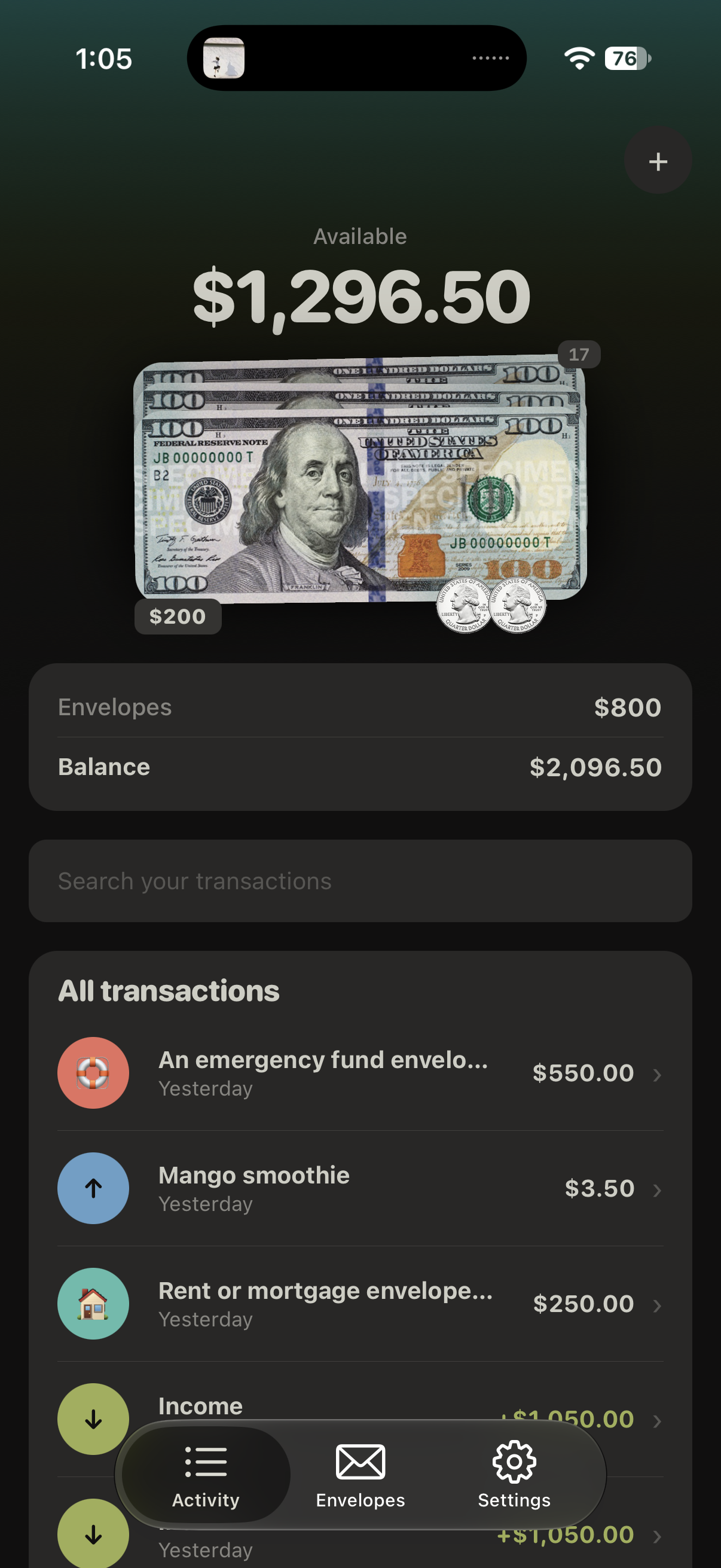
The interaction itself is a design factor in its own right. When money moves, the user should be able to see it move. If $500 is moved into an envelope, the experience should communicate that $500 has actually left the available balance and been set aside. If $40 is spent from that envelope, the user should be able to see that money leave it. These interactions aren't decorative, they're meant to reinforce the relationship between a financial decision and its consequence.
At the same time, none of that visual reinforcement can come at the expense of speed. Someone should be able to record a transaction, check a balance, and understand their finances without friction. And an envelope was never meant to be a rule about what someone can or can't spend, it's simply a way of giving money a purpose before it's spent.
Explore. Test. Refine.
Before settling on a direction, I spent time in a handful of other budgeting and envelope apps already on the market, looking at how they each handled the same core problem: representing money that doesn't physically exist in a way that still feels real.
Some of what I found worked well, I kept. Where a flow felt slow, overly gamified, or where the numbers still felt abstract even with a nicer interface, I tried a different approach and tested it against how it actually felt to move money around. A lot of the interaction design in Envelope came out of that back and forth: try a pattern, see whether it actually made money feel more tangible, then keep it or throw it out.
From idea to interaction.
Give your money a purpose.
Create envelopes for what matters and watch your goals get closer.
See the bigger picture.
Understand your spending, spot patterns, and know where your money goes.
Make progress you can see.
Watch your envelopes grow as you save toward what matters.
Track spending as it happens.
Choose where it came from, add a category, and keep your budget up to date.
Looking back. Moving forward.
Ultimately, the app should give people something that digital money has gradually taken away: a sense of where their money actually is.
Envelope is still in testing, and the parts I care about most, actually seeing money move between envelopes, are the pieces I'm continuing to refine. The goal was never to make budgeting feel like a game. It was to make it feel like money again.